PARE Interviews
Reimagining Rheumatology: A conversation about CAR-T Therapy
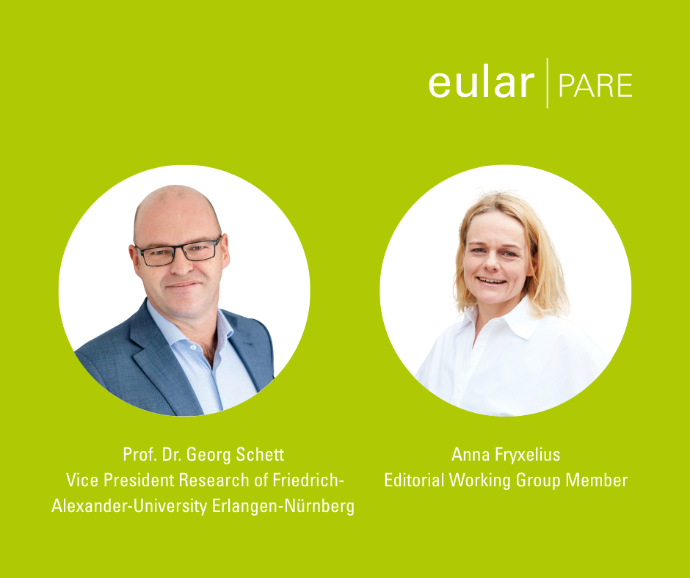
Anna Fryxelius, member of the PARE Editorial Working Group, interviews Professor Dr. Georg Schett, a leading international expert in rheumatology and immunology, to discuss how CAR-T therapy is reshaping our understanding of autoimmune rheumatic diseases — and why he believes a cure may now be within reach.
Prof. Dr. Georg Schett (Photo: Simone Kessler / University Hospital Erlangen)
Anna (Photo: Thomas Qvale / Tinagent)
Anna: Why is CAR-T therapy being described as a paradigm shift in rheumatology?
Prof. Georg Schett: The big advance of CAR-T cell therapy is that it’s a single-shot treatment. Patients stop all immunosuppressive medication beforehand, and many achieve a drug-free state afterwards — something conventional therapies cannot offer. Standard treatments suppress the disease but must be continued; stopping them often leads to relapse.
Cellular therapies are fundamentally different. CAR-T acts like a “reset button”: one infusion can eliminate the pathological immune cells. What surprised us was that patients not only went into remission — they remained well, with a normal immune system rebuilding itself. This brings major benefits: patients feel safer, immune defence is normal, and infections are less frequent. Fertility is also preserved, which is crucial for our many young female patients. We have already seen multiple healthy pregnancies after CAR-T therapy.
Anna: That sounds almost like a cure. Is that what you think is possible?
Prof. Georg Schett: Yes — and I want patients to know this. It is possible to cure autoimmune disease. We should stop treating these conditions as inevitably chronic. The goal must be to cure, not just suppress.
Anna: How can Europe strengthen its research ecosystem to enable breakthroughs like this?
Prof. Georg Schett: Funding is important, but vision matters even more. Big pharmaceutical companies had the tools for CAR-T for years, but they didn’t apply them to autoimmunity. The missing ingredient wasn’t money — it was imagination. What we need are bold, new ideas. Our CAR-T story shows it’s possible when people follow a strong vision with determination.
Anna: What role do you see the patient organisations in EULAR have in making this happen?
Prof. Georg Schett: A vital one. Patient organisations can raise awareness, inform people about trials, identify who might benefit — and advocate for fair access and funding. Without their voice, many who could benefit may never hear about these opportunities.
Anna: What’s next for CAR-T therapy?
Prof. Georg Schett: The field is evolving rapidly — from using patients’ own cells (autologous CAR-T) to allogeneic CAR-T (one “off-the-shelf” product for many), and even in-body CAR-T generation using mRNA nanoparticles, similar to vaccines. These advances could make CAR-T far more scalable and available to many patients across the world.
Anna: Thank you for sharing these valuable insights.